
As generative AI rapidly enters the field of scientific image creation, more authors hope to use AI tools to produce journal covers, graphical abstracts, or illustrations. But in reality, different publishers and journals have drastically different rules. Some completely prohibit AI-generated images, some allow them with strict disclosure, and others follow a mixed model in which covers are more flexible while in-article figures are more strictly regulated.
This article summarizes current policies of major publishers regarding AI-generated cover art and illustrations, provides representative examples, and offers a practical checklist authors can use before submission.
At present, the industry can be grouped into three categories:
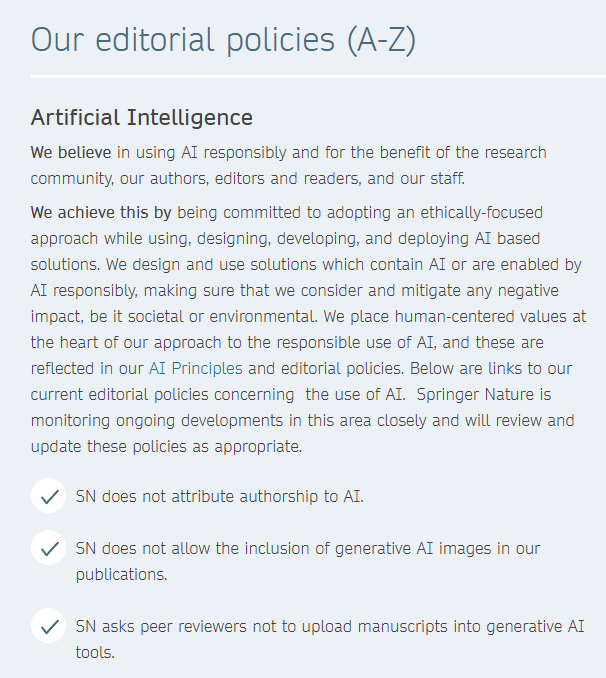
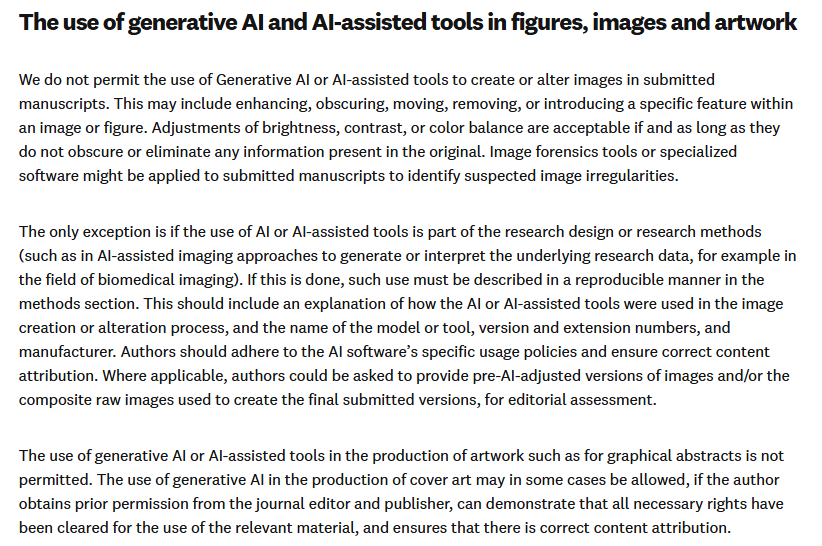
Some large publishers explicitly state that they do not allow generative-AI images in the scientific figures inside manuscripts. This includes Springer Nature (e.g., Nature, Scientific Reports) and Taylor & Francis. These rules are driven by copyright uncertainty, research integrity risks, and the fact that AI may “invent non-existent details.”
(Many publishers have issued similar public statements.)
Some publishers are more flexible with cover artwork. For example:
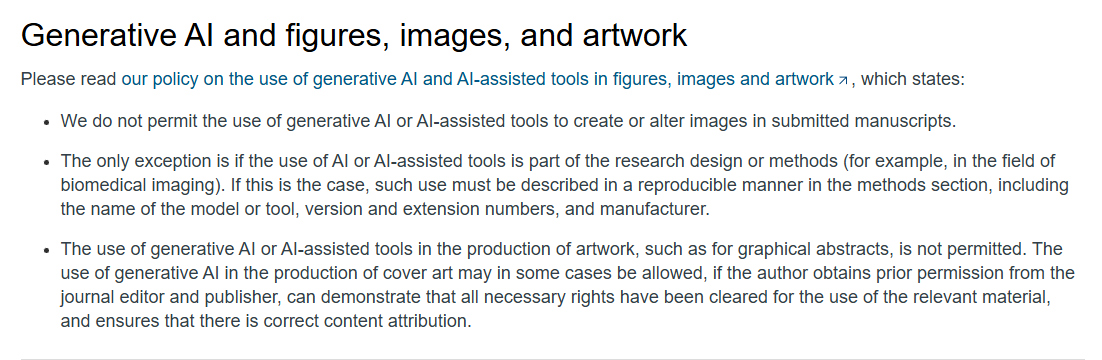
Cell Press: AI-generated cover images are allowed only with prior editorial approval, plus full disclosure of tools and workflow.
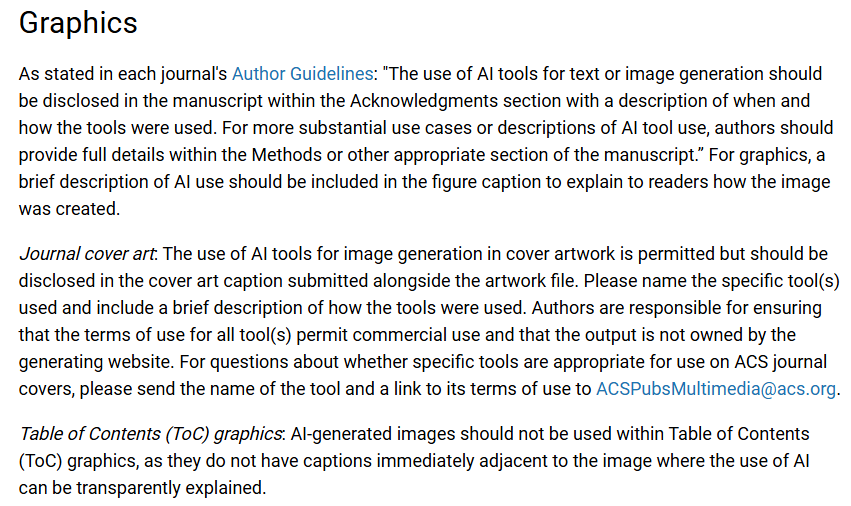
ACS (American Chemical Society): Allows AI-created cover art if authors disclose the tools used and ensure the output does not violate copyright/licensing rules.
Publishers like Elsevier and Wiley offer general AI policies, but individual journals may interpret them differently. Some strictly forbid AI images, while others allow AI-based cover art on a case-by-case basis. Always check the “Author Guidelines” and the AI or image-use section of your target journal.
Conclusion: Covers are more likely to be accepted than in-article figures, but policies differ across journals and must be verified individually.
Prohibits AI-generated images entirely (illustrations, reconstructed microscopy visuals, etc.).
Reasons include unclear copyright ownership, fabricated details, and unverifiable image authenticity.
Some covers may be exceptions, but require case-by-case editor approval.
AI-generated cover art is allowed with prior written permission from the editor.
AI is strictly prohibited for generating or replacing scientific data figures.
Authors must disclose tools (e.g., Midjourney, Stable Diffusion) in the cover description.
Supports the use of AI-generated artwork for covers, provided:
Tool usage is fully disclosed;
The AI tool’s terms allow commercial and republication use;
Authors supply raw files and creation workflow if editors request them.
Their global policies emphasize “disclosure of AI usage.”
Whether AI images are allowed depends on the specific journal.
Some journals allow AI-generated covers but require manual review and refinement by the author to ensure accuracy and compliance.
Editorial teams and the research community remain cautious toward AI images for several reasons:
AI outputs sometimes contain imagined structures, inaccurate biology, or random pseudo-text.
Some AI-generated images were mistakenly used as real data in submissions, causing community backlash.
Cover art is “decorative” and does not influence scientific conclusions, so journals are more flexible with it.
To maintain scientific rigor, most publishers clearly state:
“AI must not be used to generate or modify research data images.”
Policies change quickly and vary widely. Never rely on outdated assumptions.
Publishers such as Cell Press, Wiley, and Elsevier encourage authors to send draft cover images for pre-review.
In the cover description, specify:
Which AI tools you used,
What manual edits were applied,
Whether additional external assets were incorporated.
If your AI tool does not guarantee “commercial and publication-safe rights,” editors may reject the artwork.
Save prompts, sketches, source images, and version files in case editors request verification.
This is a universal rule across nearly all journals.
These standards are also helpful when producing conference posters or working on figure Design, and the “AI-assisted + manual refinement” model is increasingly common even in areas such as Thesis cover design.
As generative AI becomes mainstream, journals are rapidly updating their image policies. Expect clearer distinctions such as:
Different rules for data figures vs. decorative illustrations vs. cover art;
Standardized AI disclosure formats;
Stronger scrutiny around copyright and image integrity.
Authors should stay alert and always check the latest submission guidelines.
Most publishers prohibit AI-generated figure images inside papers, especially those related to experimental data.
Some publishers allow AI-assisted cover art with pre-approval and full disclosure (e.g., Cell Press, ACS).
Policies vary by journal; always review the latest Author Guidelines before submission.
Anhui Province Academy of Science and Technology, No. 128,Wanshui Road, Hi-Tech Zone, Hefei City, Anhui Province, China
 +86 17354022649
 service@sondii.com


ساعات عملنا
الإثنين 21/11 - الأربعاء 23/11: 9 صباحًا - 8 مساءً
الخميس 24/11: مغلق - عيد شكر سعيد!
الجمعة 25/11: 8 صباحًا - 10 مساءً
السبت 26/11 - الأحد 27/11: 10 صباحًا - 9 مساءً
(جميع الساعات بالتوقيت الشرقي)
 IPv6 دعم الشبكة