
Published in Advanced Materials, Volume 38, Issue 14
We are delighted to share that our scientific cover design has been featured in Advanced Materials, highlighting groundbreaking research by Xiao-Liang Ge, Su Xu, Tian-Tai Zhang, Zhuo-Tong Li, Jia-Qi Feng, Hang Ren, Dong-Dong Han, and Yong-Lai Zhang from Jilin University.
The featured research, “Self-Adaptive Mechanical Metasurface Enabling Zero-Power-Consumption Thermal Management of Electronic Devices,” introduces an innovative approach to electronic thermal management that combines thermal, mechanical, and electromagnetic functions within a single self-adaptive system.
As electronic devices become increasingly compact, integrated, and powerful, efficient thermal management has become a critical challenge.
Conventional cooling technologies often require additional space and energy consumption. In some cases, thermal management components can also interfere with the electromagnetic performance of electronic devices, affecting their operating bandwidth and efficiency.
The researchers proposed a new solution: a zero-power, self-adaptive mechanical metasurface capable of responding to temperature changes without requiring an external power supply.
The metasurface is constructed from liquid crystal elastomers and copper. By taking advantage of the strain mismatch between these materials under heating, the periodic structural units can undergo temperature-dependent mechanical reconfiguration.
In this way, excess heat generated by electronic devices can passively trigger structural changes in the metasurface.
Rather than relying on an external energy source, the system converts thermal energy into mechanical motion, creating an adaptive thermal management mechanism with zero additional power consumption.
More importantly, the researchers designed deep-subwavelength unit cells that enable mechanical reconfiguration while preserving the surface-current distribution of a Vivaldi antenna.
This effectively decouples the thermal-management function from electromagnetic performance, allowing the system to regulate heat without compromising the antenna's electromagnetic behavior.
The work therefore establishes an intriguing framework integrating thermal, mechanical, and electromagnetic functionalities into one multifunctional system.
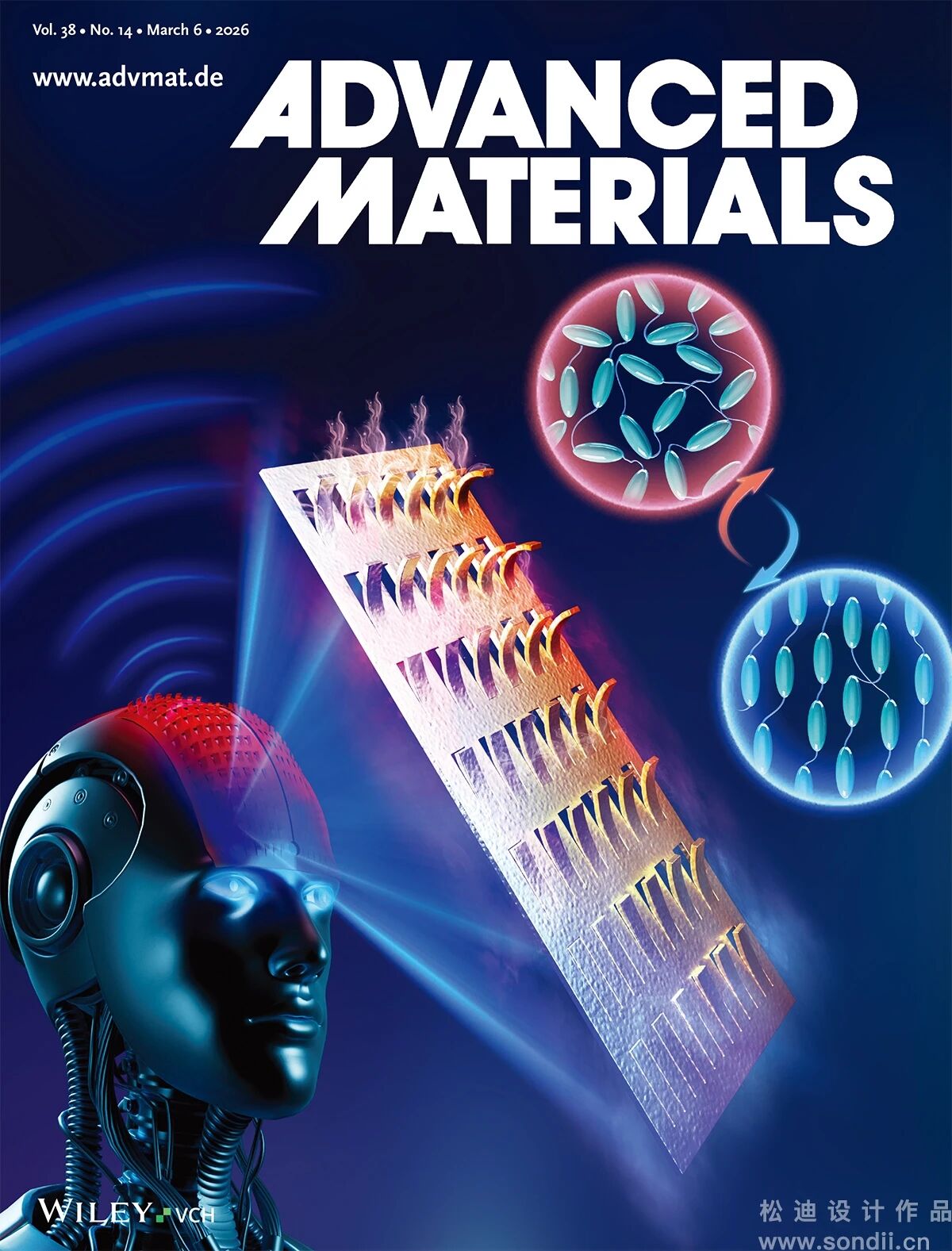
For the cover artwork, our design team focused on visually communicating the research concept while making the complex scientific mechanism accessible at a glance.
A robotic head serves as one of the main visual elements, representing advanced electronic devices and their increasingly sophisticated technological architectures.
At the center of the composition, the self-adaptive mechanical metasurface takes visual priority. Its structural transformation illustrates how the metasurface responds to heat and dynamically changes its configuration.
In the upper-right corner, a microscopic structural representation reveals the material composition of the metasurface, highlighting the combination of liquid crystal elastomers and copper and their thermally induced strain mismatch.
By combining the macroscopic application with microscopic material structures, the artwork connects the device level, material level, and physical mechanism within a single visual narrative.
The color palette was carefully developed to reinforce the scientific story.
A deep blue background creates a futuristic technological environment and provides strong visual contrast for the central structures. The robotic element incorporates black, red, and blue tones to emphasize its mechanical and technological characteristics.
The metasurface uses a combination of warm orange and yellow tones alongside cool purple hues, visually suggesting heat transfer, energy conversion, and structural transformation.
Bright blue and pink tones are used in the microscopic structure to distinguish the material components and make the underlying mechanism easier to recognize.
The resulting composition combines scientific accuracy with a sense of movement and transformation, reflecting the dynamic nature of the self-adaptive system.
The cover adopts a futuristic science-fiction aesthetic, bringing together real scientific structures, advanced electronic systems, and imaginative visual storytelling.
Rather than simply reproducing the research schematic, the artwork transforms the underlying scientific mechanism into a visual story—from heat generation to structural reconfiguration and adaptive thermal management.
This approach allows abstract and microscopic scientific processes to be communicated through a clear visual hierarchy while maintaining the sense of innovation expected from a high-impact materials science journal.
The concept presented in this research could have promising applications in advanced communication systems, wearable electronics, and other highly integrated electronic devices.
As communication technologies move toward higher frequencies and greater data rates, thermal management will become increasingly important. A passive thermal-management system that does not compromise electromagnetic performance could offer new possibilities for future electronic architectures.
For wearable systems, where space, power consumption, thermal comfort, and electromagnetic performance are particularly important, zero-power adaptive thermal management may also provide an attractive direction for future device design.
More broadly, this research demonstrates the potential of multiphysics integration as a strategy for solving complex engineering challenges.
At Sondii, we believe that effective scientific visualization goes beyond making research visually appealing. It should reveal the logic, mechanism, and significance behind a scientific discovery.
We are proud to have translated this innovative research into a cover artwork that connects materials science, thermal management, mechanics, and electronic devices through visual storytelling.
Congratulations to the research team on this remarkable achievement and successful publication in Advanced Materials!
Looking for scientific illustration or journal cover design?
Sondii creates customized scientific visualizations, journal covers, graphical abstracts, and research illustrations designed to communicate complex scientific ideas with clarity, accuracy, and visual impact.
Anhui Province Academy of Science and Technology, No. 128,Wanshui Road, Hi-Tech Zone, Hefei City, Anhui Province, China
 +86 17354022649
 service@sondii.com


ساعات عملنا
الإثنين 21/11 - الأربعاء 23/11: 9 صباحًا - 8 مساءً
الخميس 24/11: مغلق - عيد شكر سعيد!
الجمعة 25/11: 8 صباحًا - 10 مساءً
السبت 26/11 - الأحد 27/11: 10 صباحًا - 9 مساءً
(جميع الساعات بالتوقيت الشرقي)
 IPv6 دعم الشبكة